
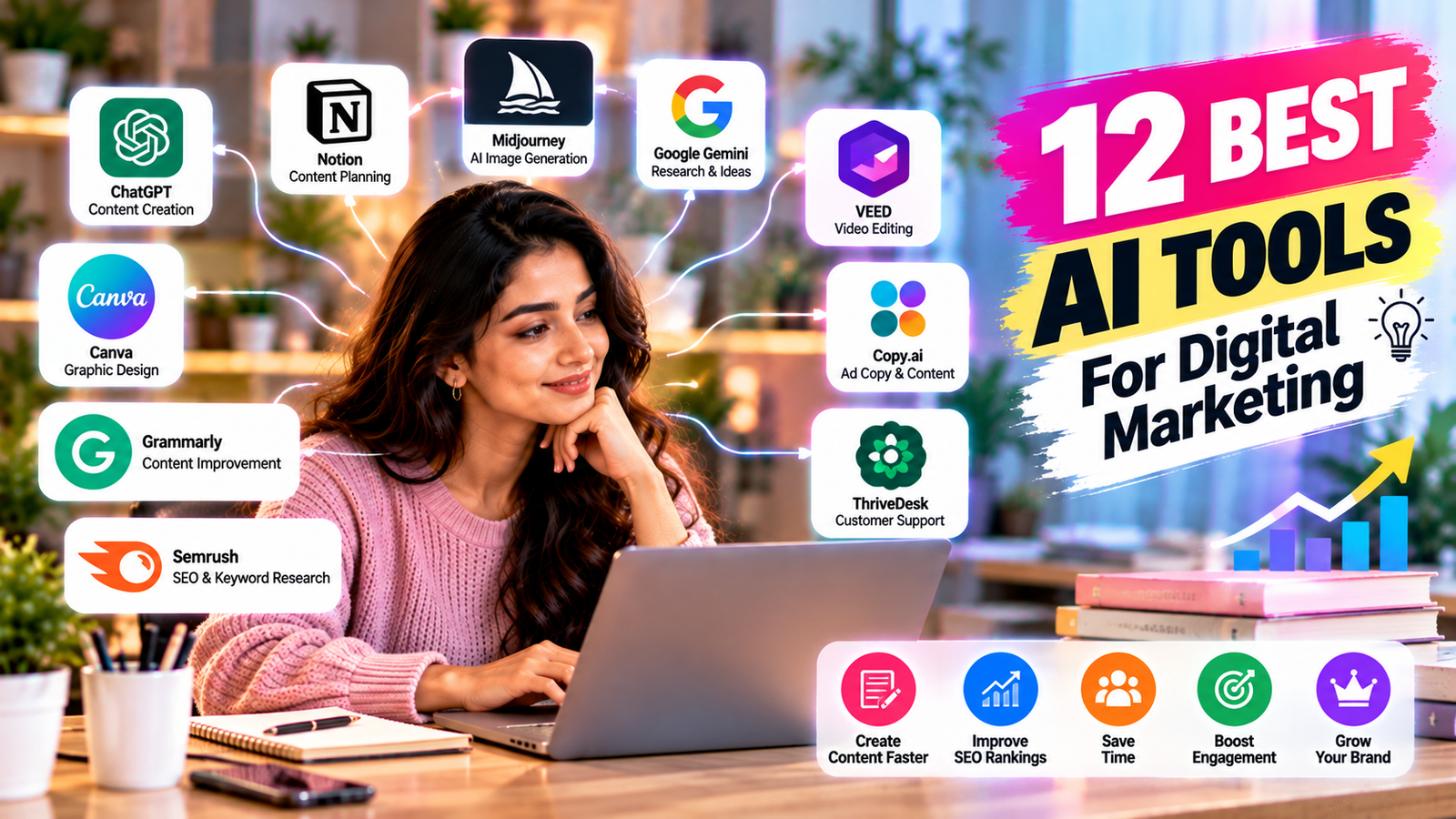
Best AI Tools for Digital Marketing in 2026: Top Tools Every Marketer Should Know

Artificial Intelligence has transformed the way businesses approach digital marketing. From creating content and designing graphics to analyzing SEO data, automating social media, generating videos, and improving advertising campaigns, AI tools are helping marketers work faster and make smarter decisions.
In 2026, using the best AI tools for digital marketing is no longer just an advantage. For businesses, agencies, freelancers, and digital marketers, AI has become an important part of building efficient and scalable marketing strategies.
In this guide, we’ll explore some of the top AI marketing tools in 2026, their uses, and how they can support different areas of digital marketing.
What Are AI Tools for Digital Marketing?
AI digital marketing tools are software platforms that use artificial intelligence and machine learning to assist with marketing activities.
They can help marketers with:
SEO and keyword research
Content writing and optimization
Social media marketing
Graphic designing
Video creation and editing
Email marketing
Competitor research
Marketing automation
Paid advertising
Data analysis and reporting
Instead of replacing marketers, the most useful AI tools can reduce repetitive work and help professionals spend more time on strategy, creativity, and decision-making.
1. ChatGPT – AI Tool for Content & Marketing Ideas
ChatGPT is one of the most versatile AI tools for digital marketers. It can assist with brainstorming, research, content planning, copywriting, campaign ideas, and analyzing information supplied by marketers.
Best Uses:
Blog topic generation
SEO content drafts
Social media captions
Ad copy ideas
Email content
Content calendars
FAQ creation
Keyword clustering
Marketing strategy brainstorming
Product descriptions
Marketers should still review AI-generated information, add original expertise, and optimize content according to search intent rather than publishing raw AI output.
2. Semrush – AI-Powered SEO & Competitor Research
Semrush is a popular digital marketing and SEO platform that combines traditional SEO data with AI-powered features.
It can help marketers research keywords, understand competitors, monitor rankings, identify backlink opportunities, and find technical SEO problems.
Best Uses:
Keyword research
Competitor analysis
Website audits
Rank tracking
Backlink analysis
Content research
PPC research
For an SEO agency or digital marketing company, tools like Semrush can make it easier to manage multiple SEO campaigns using data rather than assumptions.
3. Canva – AI-Powered Graphic Designing
Visual content plays an important role in social media and digital advertising. Canva combines easy-to-use design features with several AI-assisted creative tools.
Best Uses:
Instagram posts
Facebook creatives
Presentations
Ad creatives
YouTube thumbnails
Posters
Infographics
Marketing graphics
It is especially useful for marketers who need to create visual content quickly without relying on advanced graphic design software for every task.
4. Google Gemini – AI Assistant for Marketing & Research
Google Gemini can assist digital marketers with research, ideation, writing, analysis, and productivity tasks.
Digital Marketing Uses:
Researching topics
Brainstorming campaigns
Creating content ideas
Summarizing information
Analyzing supplied data
Developing marketing concepts
As with any generative AI platform, marketers should verify important facts and use human judgment before incorporating generated information into campaigns.
5. Ahrefs – SEO Research & Website Analysis
Ahrefs is another widely used platform for SEO, backlink analysis, keyword research, and competitor research.
Best Uses:
Finding keyword opportunities
Backlink research
Competitor analysis
Content gap analysis
Website audits
Organic traffic research
Rank tracking
Ahrefs can be particularly useful when developing a long-term organic search strategy.
6. Jasper – AI Marketing Content Platform
Jasper is designed around AI-assisted marketing content and brand communication.
Businesses and marketing teams can use it to develop and adapt content across multiple channels while maintaining greater consistency in messaging.
Best Uses:
Marketing copy
Blog content
Ad copy
Email campaigns
Product descriptions
Brand-focused content
7. Grammarly – AI Writing & Editing Assistant
Good marketing content needs more than keywords. It also needs clarity, readability, and professional communication.
Grammarly can help identify grammar problems and improve sentence structure, tone, and clarity.
Best Uses:
Blog proofreading
Email editing
Website copy
Social media content
Marketing proposals
Professional communication
It is particularly helpful as a final editing layer before content is published.
8. HubSpot – AI-Powered CRM & Marketing Automation
HubSpot combines CRM, marketing, sales, customer service, and automation capabilities.
Its AI features can assist businesses with various parts of the customer journey.
Best Uses:
Lead management
CRM
Email marketing
Marketing automation
Customer communication
Lead nurturing
Reporting
For growing businesses, connecting marketing activities with customer and sales data can provide a clearer picture of campaign performance.
9. Surfer – AI-Assisted SEO Content Optimization
Surfer is primarily focused on optimizing content for organic search.
It can help marketers evaluate content against search-related signals and identify terms, topics, and structural improvements that may increase topical relevance.
Best Uses:
SEO content optimization
Content briefs
Article structure
Topic research
On-page optimization
However, recommendations from optimization tools should be treated as guidance rather than rigid rules. Search intent and content quality remain more important than simply achieving a tool’s optimization score.
10. Adobe Firefly – AI for Creative Marketing
Adobe Firefly provides generative AI capabilities for visual creative workflows.
Digital marketers and designers can use generative tools to explore concepts and produce creative assets for campaigns.
Best Uses:
Marketing visuals
Creative concepts
Social media graphics
Advertising assets
Image generation
Image editing
11. CapCut – AI-Assisted Video Marketing
Short-form video has become an important component of social media marketing.
CapCut provides editing and AI-assisted features that can help marketers produce videos for platforms such as Instagram, YouTube, and TikTok.
Best Uses:
Instagram Reels
YouTube Shorts
Promotional videos
Social media advertisements
Captions and subtitles
Quick video editing
12. Mailchimp – AI-Assisted Email Marketing
Mailchimp combines email marketing and automation with AI-assisted functionality.
Best Uses:
Email campaigns
Audience segmentation
Marketing automation
Customer journeys
Campaign optimization
Email content assistance
Email marketing platforms can be especially valuable when businesses want to nurture leads instead of depending entirely on paid advertising.
Which AI Tool Is Best for Digital Marketing?
There isn’t one AI tool that is best for every marketing task.
A practical digital marketing toolkit could include:
Content & Ideas: ChatGPT or Jasper
SEO: Semrush, Ahrefs, or Surfer
Graphic Designing: Canva or Adobe Firefly
Video Marketing: CapCut
Writing & Editing: Grammarly
CRM & Automation: HubSpot
Email Marketing: Mailchimp
Research & Productivity: ChatGPT or Gemini
The right combination depends on your business goals, budget, team size, and marketing channels.
Benefits of Using AI in Digital Marketing
AI can provide several advantages when used responsibly.
Faster Content Production
AI can accelerate research, ideation, drafting, editing, and repurposing.
Better Data Analysis
AI-assisted tools can help marketers identify patterns and opportunities in large amounts of marketing data.
Improved Personalization
Businesses can use customer and campaign data to create more relevant marketing experiences.
Marketing Automation
Repetitive processes such as email workflows, lead nurturing, reporting, and content scheduling can often be partially automated.
Increased Productivity
By reducing repetitive work, marketers can dedicate more time to creative strategy, customer understanding, and campaign optimization.
Will AI Replace Digital Marketers?
AI is more likely to change digital marketing jobs than eliminate the need for skilled marketers.
Tools can generate copy, analyze information, create visuals, and automate processes, but successful marketing still requires an understanding of customers, positioning, creativity, strategy, brand voice, business goals, and human judgment.
The strongest approach is therefore AI + human expertise.
How to Choose the Best AI Marketing Tools
Before investing in a platform, consider your primary marketing objective, the features you actually need, integration with your existing tools, pricing, data/privacy requirements, and how much human review the workflow requires.
Avoid adopting an AI platform simply because it is trending. The best tool is the one that solves a genuine marketing problem and contributes to measurable results.
Final Thoughts
The best AI tools for digital marketing in 2026 can help marketers improve productivity across SEO, content marketing, social media, paid advertising, email marketing, graphic design, video production, and marketing automation.
Platforms such as ChatGPT, Semrush, Canva, Gemini, Ahrefs, Jasper, Grammarly, HubSpot, Surfer, Adobe Firefly, CapCut, and Mailchimp each address different parts of the digital marketing workflow.
However, tools alone do not create a successful digital marketing strategy. Combining AI technology with creativity, SEO expertise, data analysis, and human decision-making is what turns these tools into meaningful business results.