
Your bidding strategy decides how Google spends your budget in every auction. The wrong choice can waste money on clicks that never convert, while the right one aligns spending with your real business goal. Here is how to pick and evolve your Google Ads bidding strategy.
Quick answer: Choose a Google Ads bidding strategy based on your goal and data: use Maximise Clicks or Manual CPC for new campaigns without conversion data, Maximise Conversions once tracking works, Target CPA when you have steady leads, and Target ROAS for e-commerce with purchase values.
Why It Matters
Smart bidding uses signals such as device, location, time and audience to adjust bids in real time. When it has enough accurate conversion data it often outperforms manual bidding, but without data it can overspend. Matching strategy to campaign maturity protects your budget.
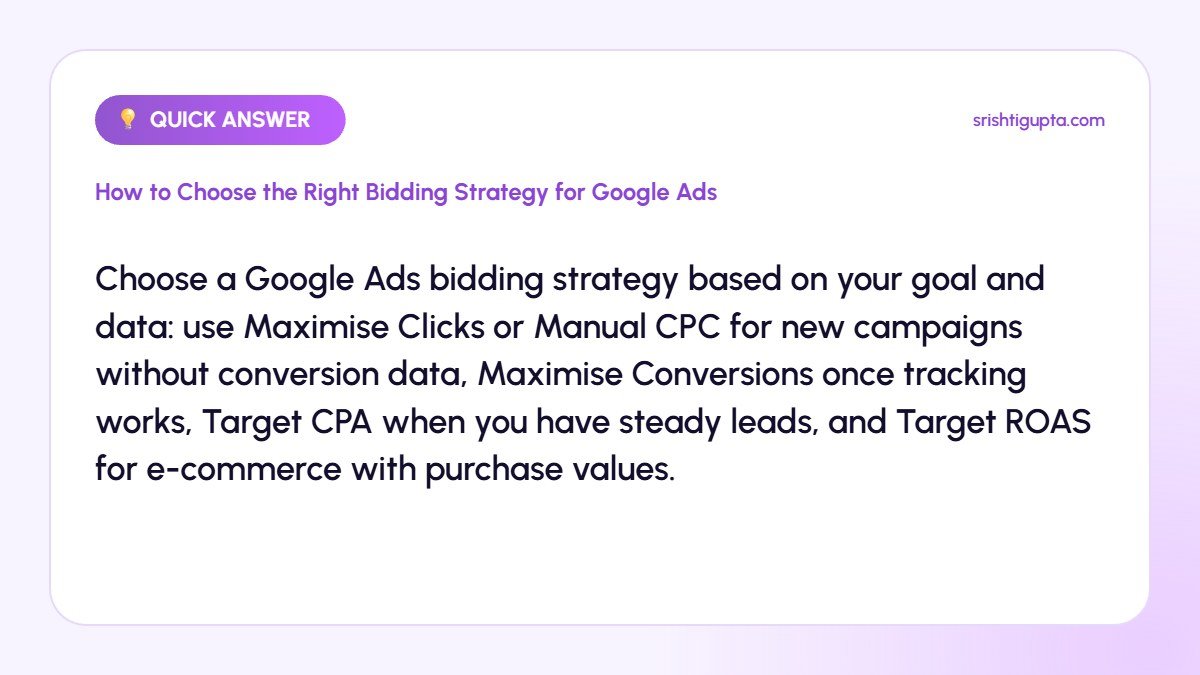
Step-by-Step: How to Choose the Right Bidding Strategy for Google Ads
Step 1: Define the campaign goal
Decide whether you want traffic, leads, sales value or visibility. Your goal determines which strategies make sense, so write it down before creating the campaign.
Step 2: Check your conversion tracking
Smart bidding needs reliable conversion data. Confirm that leads or purchases are tracked correctly in Google Ads or imported from GA4, and that values are attached for e-commerce.
Step 3: Start simple for new campaigns
With no conversion history, use Maximise Clicks with a maximum CPC limit or Manual CPC. This gathers data on which keywords and searches work without letting automation spend freely.
Step 4: Move to Maximise Conversions
Once the campaign records conversions consistently, switch to Maximise Conversions so Google bids more for searches likely to convert within your daily budget.
Step 5: Add targets when data is stable
After around 30 or more conversions a month, test Target CPA for lead generation or Target ROAS for online stores. Set targets close to your current averages and adjust gradually.
Step 6: Monitor and adjust carefully
Allow one to two weeks of learning after each change. Review cost per conversion, conversion rate and search terms, and avoid changing strategies too often.
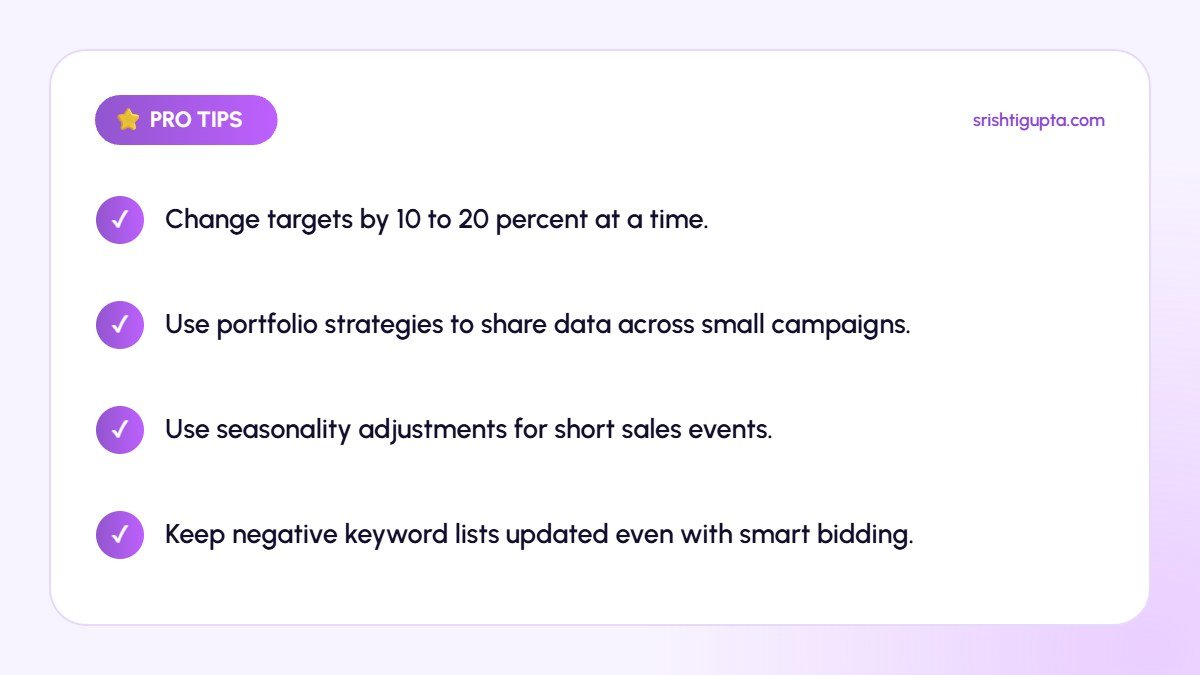
Pro Tips
- Change targets by 10 to 20 percent at a time.
- Use portfolio strategies to share data across small campaigns.
- Use seasonality adjustments for short sales events.
- Keep negative keyword lists updated even with smart bidding.
Common Mistakes to Avoid
- Using Target CPA without enough conversion data.
- Counting low-value actions like page views as conversions.
- Changing bidding strategy every few days.
- Setting unrealistically low targets that stop the campaign spending.
Frequently Asked Questions
Which Google Ads bidding strategy is best for beginners?
Maximise Clicks with a CPC cap or Manual CPC is usually safest at the start, followed by Maximise Conversions once tracking shows results.
How much data does smart bidding need?
Google can work with less, but strategies like Target CPA and Target ROAS are more stable with around 30 or more conversions in 30 days.
What is the learning period in Google Ads?
After a bidding change, Google needs time to adjust. Performance may fluctuate for about one to two weeks while the system learns.
Final Thoughts
There is no single best bidding strategy, only the right one for your campaign stage. Start simple, build strong conversion data and progress to targets gradually to get the most value from every rupee you spend on Google Ads.
Need expert help? Srishti Gupta is a digital marketing expert in Ludhiana. Explore her Google Ads management or get in touch to discuss your project.