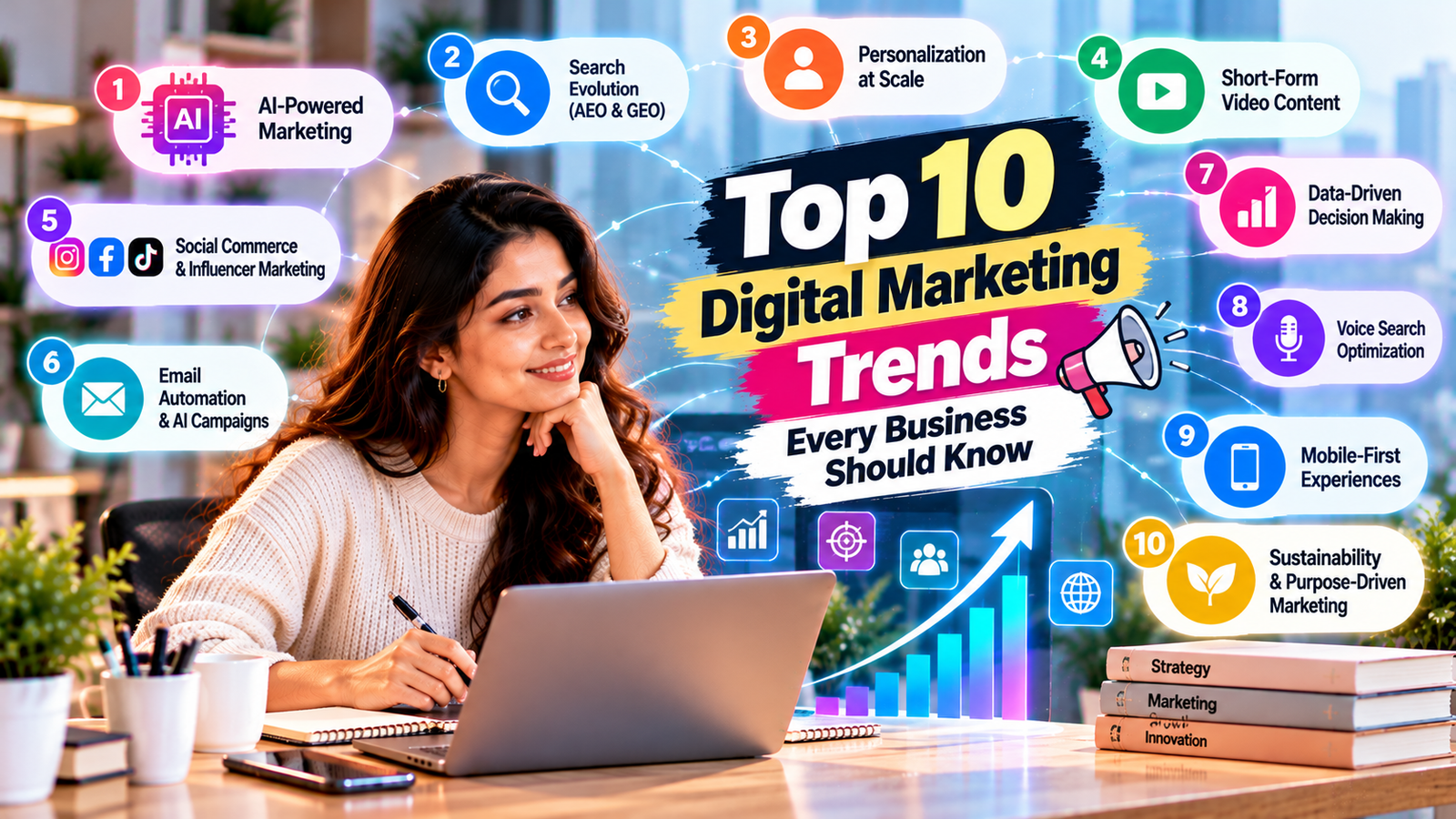
Top 10 Digital Marketing Trends in 2026 Every Business Should Know
Digital marketing is changing rapidly. New technologies, changing customer behavior, and AI-powered platforms are transforming the way businesses attract, engage, and convert customers.
In 2026, businesses cannot rely only on traditional SEO or social media. They need to understand emerging digital marketing trends and adapt their strategies accordingly.
Here are the top 10 digital marketing trends in 2026 that every business should know.
AI-Powered Digital Marketing
Artificial intelligence is becoming an important part of modern marketing. Businesses are using AI to analyze customer behavior, generate content ideas, automate repetitive tasks, and personalize marketing campaigns.
AI can save time and help marketers make faster, data-driven decisions.
Tip: Use AI as a marketing assistant, but keep human creativity, experience, and brand voice at the center.
Generative Engine Optimization (GEO)
Search is changing with the growth of AI-powered search and answer engines. This makes Generative Engine Optimization (GEO) an important digital marketing strategy.
Instead of focusing only on traditional search rankings, businesses should create helpful content that AI systems can easily understand, trust, and reference.
Focus on:
- Clear and useful answers
- Original information
- Relevant keywords
- Strong expertise and credibility
- Well-structured content
Short-Form Video Marketing
Short-form videos continue to be one of the most effective ways to capture attention online.
Platforms such as Instagram Reels and YouTube Shorts allow businesses to showcase products, answer questions, share tips, and build brand awareness.
Tip: Create short videos that educate, entertain, or solve a specific customer problem.
Social Media Search
Social media is becoming more than a platform for posting content. People increasingly use social platforms to discover products, services, brands, and information.
Businesses should optimize their social profiles and content using relevant keywords.
Use keywords naturally in:
- Captions
- Video titles
- Descriptions
- Profiles
- Hashtags
Personalized Marketing
Customers want relevant experiences rather than generic advertisements.
Personalized emails, product recommendations, offers, and website experiences can help businesses connect with their audiences more effectively.
The goal is simple: show the right content to the right audience at the right time.
First-Party Data
Privacy concerns are changing how businesses collect and use customer information.
First-party data collected directly through websites, email subscriptions, customer interactions, and CRM systems can help businesses understand their audiences while building stronger customer relationships.
Businesses should focus on collecting data transparently and using it responsibly.
Interactive Content
Interactive content can make digital experiences more engaging.
Businesses can use:
- Quizzes
- Polls
- Calculators
- Interactive infographics
- Surveys
- Product configurators
Instead of simply asking users to read or watch, interactive content encourages them to participate.
Influencer and Creator Marketing
Influencer marketing continues to evolve. Businesses are increasingly looking beyond follower counts and choosing creators based on audience relevance, engagement, authenticity, and trust.
A smaller creator with a highly relevant audience can sometimes deliver better results than a large account with a less-targeted audience.
Voice and Conversational Search
People are increasingly using conversational phrases when searching for information.
For example, instead of searching only for:
“digital marketing services”
a user might search:
“What digital marketing services does a small business need?”
Creating content around natural questions can help businesses reach users at different stages of the customer journey.
Omnichannel Marketing
Customers can interact with a brand across multiple platforms before making a decision.
They may discover a business through Google, watch its video on YouTube, visit Instagram, read a blog, and finally visit the website.
An effective omnichannel marketing strategy keeps the brand experience consistent across these different touchpoints.
Quick Digital Marketing Trends Flowchart
AI & Automation
↓
GEO & Search Optimization
↓
Video & Social Search
↓
Personalization & First-Party Data
↓
Interactive & Creator Content
↓
Omnichannel Marketing
↓
Better Reach + Engagement + Conversions
How Can Businesses Prepare for These Trends?
You don’t need to adopt every trend at once. Start with the strategies that match your business goals and audience.
Step 1: Understand Your Audience
Identify what your customers search for, watch, read, and share.
Step 2: Strengthen Your Content
Create useful, original, easy-to-understand content that answers real customer questions.
Step 3: Use AI Strategically
Use AI for research, ideas, automation, and analysis while maintaining human oversight.
Step 4: Diversify Your Channels
Combine SEO, social media, video, email, and other relevant marketing channels.
Step 5: Measure Your Results
Track traffic, engagement, leads, conversions, and customer behavior to understand what is actually working.
Conclusion
The future of digital marketing is becoming more AI-driven, personalized, visual, conversational, and customer-focused.
Businesses that adapt to these changes can improve their online visibility, connect with customers more effectively, and create stronger digital experiences.
You don’t need to follow every new trend. The key is to identify the trends that align with your business and use them consistently.